Written by Denys Havryliak
Swift for iOS Development: A Practical Guide for 2026
Why Swift powers every modern native iOS app. Optionals, closures, common mistakes, and how to actually learn the language without wasting months.
TL;DR
- Swift is the only serious choice for iOS, macOS, watchOS, and tvOS in 2026 — Objective-C is legacy, full stop
- Swift 6 catches data races at compile time. We've already migrated three client codebases to it
- The non-negotiables: optionals, closures, ARC, async/await — skip any of these and your app leaks memory in production
- Free path that actually works: 100 Days of SwiftUI, then Stanford CS193P. Stop paying for bootcamps
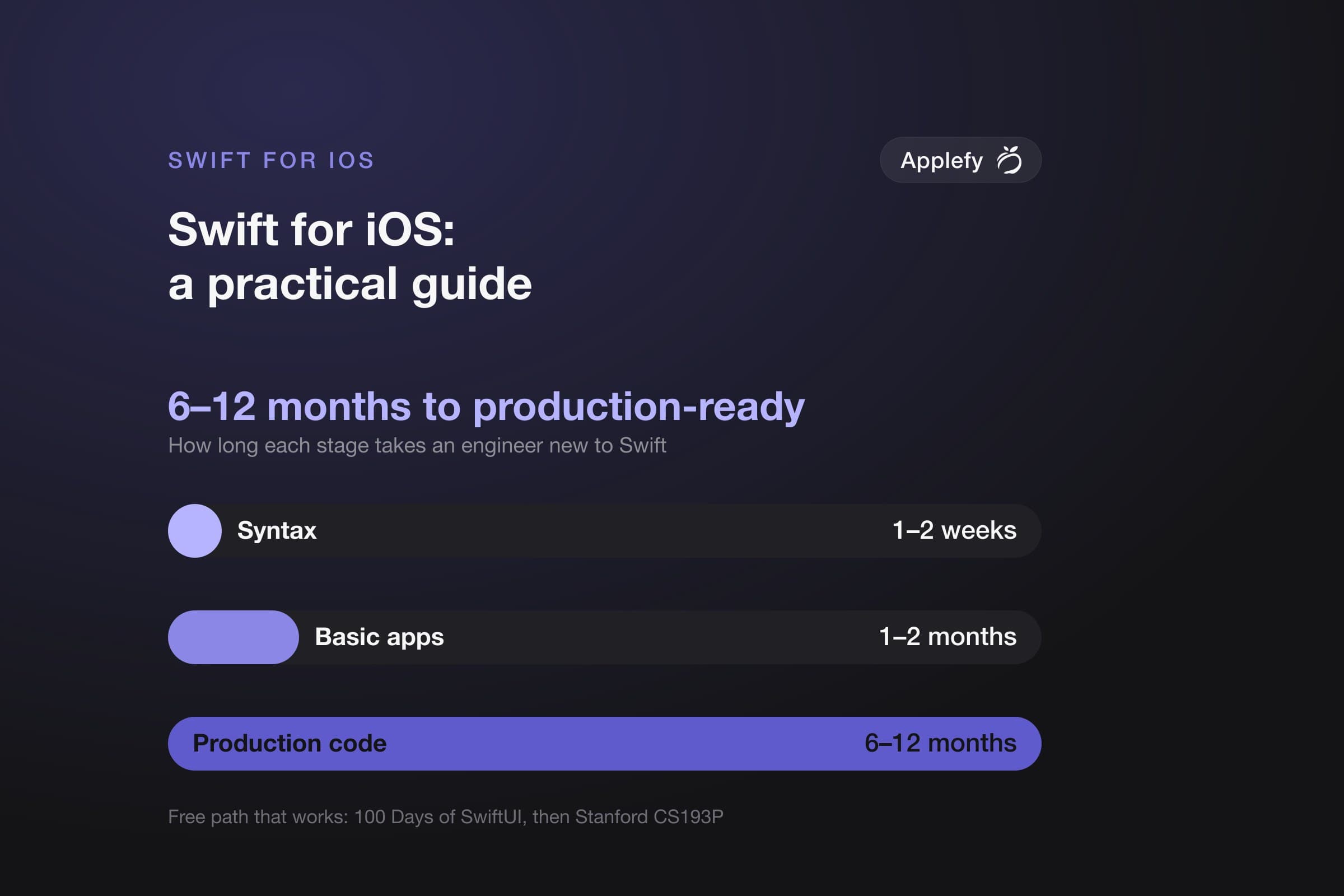
- Real timeline: 1–2 weeks for syntax, 1–2 months for basic apps, 6–12 months before we'd let you near a production codebase
We've shipped Swift apps to the App Store and inherited enough broken codebases from other studios to know exactly where things go wrong.
Swift is not a choice. If you're building native iOS, you write Swift. End of conversation.
We've reviewed enough handover code to spot bad Swift in 30 seconds. Force-unwrapped optionals everywhere. Retain cycles nobody caught until memory usage spiked at 5,000 users. Networking still written as nested completion handlers in 2026.
Here's what makes Swift different, where to actually learn it, and the patterns we rip out of every codebase we inherit.
Why Swift Matters for iOS
Swift is the language Apple builds for. New iOS APIs ship Swift-first. Performance improvements land in Swift directly. There's no translation layer.
Objective-C still runs on every iPhone. Old codebases are full of it. But new development is Swift. Period. Apple's recent frameworks — SwiftData, SwiftUI, Observation — are Swift-only.
If you're starting in 2026, you're starting in Swift. Anyone telling you otherwise is selling something.
Swift vs Other Mobile Languages
| Feature | Swift | Objective-C | Kotlin (Android) |
|---|---|---|---|
| Modern syntax | Yes | No | Yes |
| Built-in null safety | Yes (optionals) | No | Yes |
| Memory management | ARC (automatic) | ARC | Garbage collected |
| Concurrency model | async/await (Swift 5.5+) | GCD | Coroutines |
| Apple's primary focus | Yes | Legacy | N/A |
| First-class for new APIs | Yes | No | N/A |
Where to Learn Swift
Start: Swift Playgrounds and Hacking With Swift
Swift Playgrounds (Apple's free iPad/Mac app) teaches syntax interactively. Hacking With Swift at hackingwithswift.com is the single best free resource on the internet. 100 Days of SwiftUI is the path. We point every junior engineer there in their first week.
Go Deeper: Stanford CS193P
Stanford's iOS course on YouTube. Free. Excellent. Refreshed regularly; the current edition is from 2025. It teaches you to think architecturally instead of copying patterns. Watch it after you can write basic Swift, not before.
Official Docs: Swift.org and Apple Developer
The Swift language reference at docs.swift.org and Apple's developer docs are the authoritative source. They're reference material. Use them when you're building, not when you're starting.
For the full breakdown, see our iOS development courses guide.
Recommended Learning Path
| Stage | Resource | Time |
|---|---|---|
| Syntax basics | Swift Playgrounds | 1–2 weeks |
| First real app | 100 Days of SwiftUI (Hacking With Swift) | 2–3 months |
| Architecture thinking | Stanford CS193P | 1–2 months |
| Production patterns | Real project + Instruments profiling | Ongoing |
What Makes Swift Different
Optionals
Swift's most distinctive feature. Instead of crashing on nil, Swift forces you to handle the nil case. Either there's a value or there isn't, and you write code for both.
This kills entire categories of crashes. Swift apps crash less in production. Not because Swift devs are smarter — because the compiler refuses to ship the bug.
Type Inference and Safety
Swift infers types in most cases. let name = "Denys" — Swift knows it's a String. Static-typing safety, none of the verbosity.
Wrong type in a function call? Compiler error, not a 3 a.m. crash report.
Closures
First-class. Every callback, animation, network call, and UI event uses them. If you don't get closures, you don't get iOS.
Automatic Memory Management
ARC handles most of it. But two objects holding strong references to each other will leak forever. weak and unowned exist for a reason. Profile in Instruments before you ship. We catch retain cycles in client apps every single month.
Concurrency: async/await
Modern Swift uses async/await. Network calls, database reads, heavy compute — all clean, no callback hell. Swift 6 enforces data-race safety at compile time. Learn it early. If a contractor wrote new networking with completion handlers in 2026, that's a red flag.
How to Actually Learn Swift
Write code every day. Reading does almost nothing. Build, break, fix.
Pick a project you actually want to exist. Not a todo list. Something that hurts when it doesn't work. The motivation carries you through the hard parts.
Submit to TestFlight inside the first month. Provisioning profiles, certificates, App Store Connect — the deployment workflow is its own skill. Don't learn it on launch day.
What We See in Production
Three patterns we find in nearly every codebase we inherit:
Force unwraps as shortcuts. someOptional! crashes when nil. It's the Swift way of pretending the bug doesn't exist. We catch these in code review. Most teams don't review at that depth.
Delegate patterns without weak. The classic retain cycle. Object A holds B, B holds A, neither deallocates, memory climbs, app slows. Users notice before the team does. We caught one of these in Kiolfast early — the app we built for Tarik Deljanin runs lean because we profiled with Instruments before every release.
Old async patterns in new code. Completion handlers still work. They shouldn't be in code written this year. async/await is cleaner, safer, and where Apple is going. New networking with completion handlers in 2026 is a signal to keep looking.
Common Mistakes
Overusing !. Beginners use it to silence the compiler. We use it almost never. Use if let and guard let.
Ignoring memory management. ARC handles 90%. The remaining 10% leaks if you don't think about it. Instruments is not optional.
Shipping tutorial code. Tutorials work in tutorials. They break in your architecture. Understand the pattern, don't paste the code.
Skipping Swift concurrency. Callback async still compiles. It shouldn't be in new code.
The Learning Curve
Syntax: 1–2 weeks. Basic apps: 1–2 months. Production code: 6–12 months. Confident architecture: 2–3 years.
The curve is real. Don't expect to ship quality after a week of tutorials. Do expect to ship something functional. Improve from there. We hire engineers in the production-code zone, not the tutorial zone.
Frequently Asked Questions
Is Swift hard to learn?
Harder than Python, easier than C++. Syntax is modern and readable. The hard parts are iOS-specific — optionals, memory management, UIKit/SwiftUI patterns — not the language.
Should I learn Swift or Objective-C?
Swift. Objective-C is legacy. You'll read it in old codebases. You won't write it in new ones.
How is Swift different from other languages?
Optionals are the differentiator. Explicit nil handling isn't common in mainstream languages. The type system is stricter than Python or JavaScript, and performance is closer to C++ than to interpreted languages.
Is Swift only for Apple platforms?
No. It's open source and runs on Linux and Windows. But the ecosystem lives on Apple platforms. That's where you'll use it.
What's the best way to practice Swift?
Build real things. 100 Days of SwiftUI, then your own project, then TestFlight. The workflow teaches as much as the language.
Related articles
- Native iOS & Android App Development Agency in Valencia, SpainAgencies
- Native Swift vs Flutter vs React Native: RAM, CPU and Real EfficiencyDevelopment
- Swift vs Flutter: RAM, CPU and What the Measurements Actually SayDevelopment